


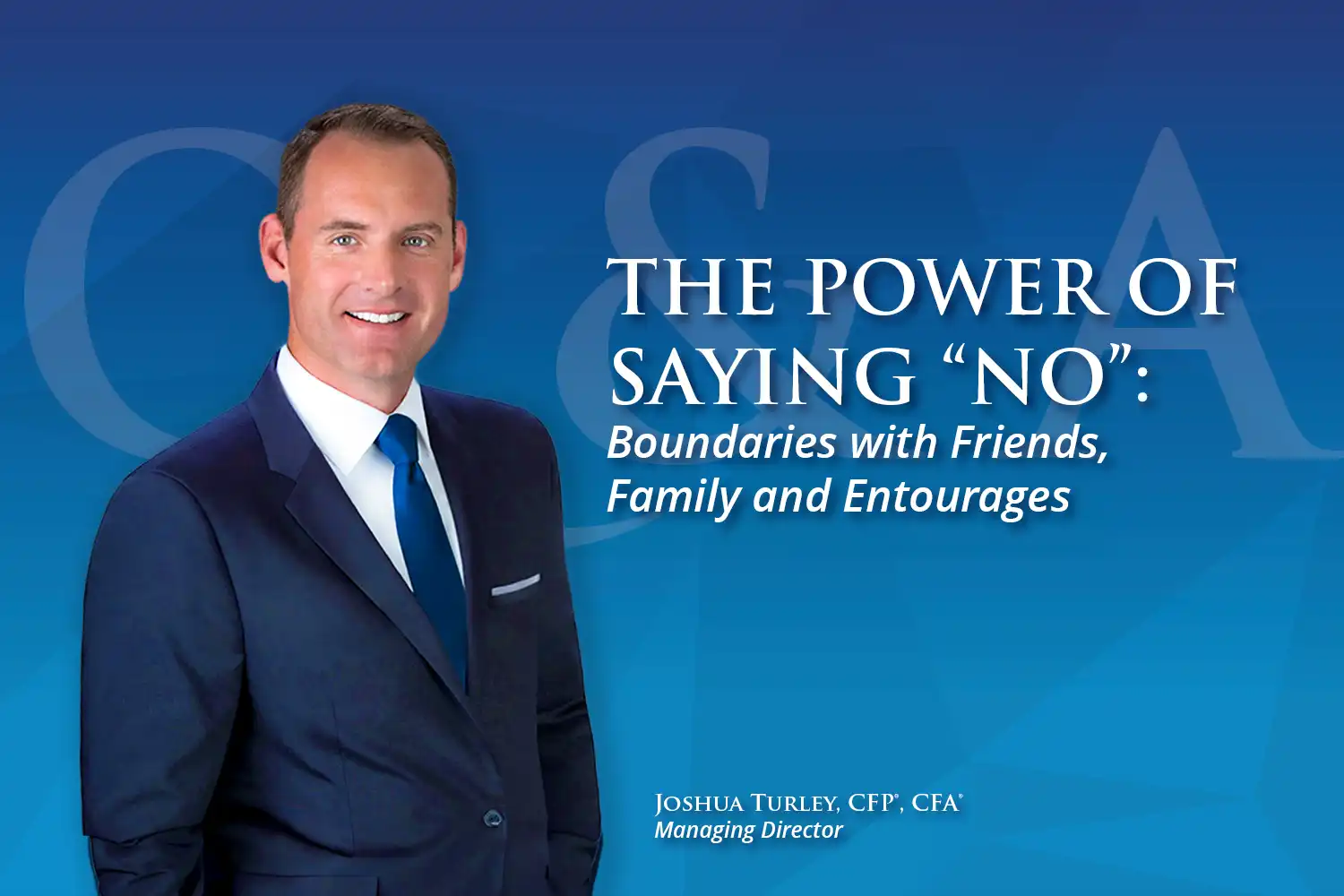
Mar 02, 2026 The Power of Saying “No”: Boundaries with Friends, Family, and Entourages
In the high-stakes world of professional sports, where multimillion-dollar contracts can turn young athletes into instant millionaires, the influx of wealth often brings an entourage of well-meaning—but sometimes boundary-testing—friends, family, and advisors. Sudden success can strain relationships, expose financial vulnerabilities, and lead to impulsive decisions that jeopardize long-term security. For team executives and legal counsel, guiding players through these dynamics is as crucial as negotiating the next deal.
Joshua Turley, CFP®, CFA®, Managing Director at TSG Wealth Management and a Co-Founder of TSG’s Sports & Entertainment Team, brings over 20 years of experience helping high-profile clients navigate these personal and financial minefields. As a CERTIFIED FINANCIAL PLANNER® and Chartered Financial Analyst®, Josh has advised athletes and entertainers on everything from contract structuring to legacy planning, always emphasizing the importance of clear boundaries to preserve both wealth and well-being.
Can you share a bit about your background and why boundaries are a critical point for you in working with sports clients?
I’ve been in wealth management for more than two decades, starting my career at a boutique practice focused on high-net-worth individuals before joining TSG Wealth Management in 2020. As a Co-Founder of our Sports & Entertainment Team, I’ve had the privilege of working with professional athletes across the major leagues, from NFL rookies to NBA veterans, as well as entertainers in film and music. I hold my CFP® and CFA® certifications because I believe in blending rigorous financial analysis with empathetic planning—it’s what allows us to address not just the numbers, but the human side of success.
Why are boundaries so important? In sports, success often happens fast, and with it comes the spotlight. Suddenly, you’re not just an athlete; you’re a family anchor, a community hero, and in some cases, an ATM for everyone around you. I’ve seen too many athletes wake up to depleted accounts because they couldn’t say “no” to a cousin’s “surefire” business idea or a friend’s luxury vacation pitch. Protecting boundaries isn’t about being cold — it’s about sustainability in the long term. It’s why our team follows the “4 A’s”: Appreciate the client’s unique profile, Advise on tailored strategies, Assemble the right resources, and Achieve lasting goals. Boundaries are the foundation of that last one.
Why is setting boundaries especially challenging for athletes and entertainers compared to other high-net-worth clients?
Traditional high-net-worth clients, like corporate execs, often build wealth gradually with support systems already in place. In sports and entertainment, it’s a pressure cooker: short career spans, irregular income from endorsements and bonuses, and an entourage that swells overnight. That “jock tax” complexity we deal with — filing in multiple states — or the “jock block” where family pressures block rational decisions? It amplifies everything. Add public scrutiny, and saying “no” feels like risking relationships that got you through the minors or the audition grind.
Emotionally, athletes are wired for yes—team players who thrive on collaboration. But without boundaries, that generosity becomes a liability. Our role is to normalize this “financial whirlwind,” as we call it, by scripting those tough conversations early.
Tell us about TSG Sports & Entertainment team’s approach to helping clients with entourage dynamics.
Our team — led by TSG Partner, Allen Schreiber, Brock Wilson, President of TSG Sports & Entertainment and myself — is built for this niche. We’re not generalists; we’ve lived the cycles of draft-day highs and injury lows. We start with “Financial Normalization”: mapping out revenue streams, from NIL deals for college stars to deferred comp for vets, and identifying entourage “red flags” like unsolicited investment pitches.
We emphasize integrated planning: coordinating with legal counsel on family trusts or prenups that enshrine boundaries, while our TSG tax experts handle the backend. It’s about empowering the client as the CEO of their financial life, with us as the CFO, helping them set and enforce the guardrails.
What are some common emotional pitfalls when dealing with requests from friends and family, and how can athletes reframe them?
Guilt is the big one — athletes often come from modest backgrounds where sharing was survival. A “no” feels like betrayal. Or fear of isolation: “If I say no, will they abandon me?” Reframing starts with empathy: Acknowledge the ask (“I get why this excites you”) then pivot to shared vision (“But let’s align it with our family legacy goals”).
Tactically, we teach the “pause protocol”: Never decide in the moment. Sleep on it, consult your inner circle (us, your agent, your therapist, etc.), and respond with alternatives — for example, you may try matching a family investment up to 5%, or gifting experiences over cash. Emotionally, it’s boundary-building exercise, but ultimately it’s about becoming the leader, not the lender.
On the financial side, how do you help clients preserve their wealth from entourage overreach?
We layer in structural safeguards. First, cash flow budgeting: We help our clients allocate “generosity buckets” based on their goals — for example, it may be that 10% of annual income is set aside for family support — beyond which requests trigger a formal review. This prevents impulse wire transfers that could trigger certain problems like IRS gift taxes.
Legally, we collaborate with attorneys on revocable trusts or LLCs for family ventures, helping to ensure our client retains control. For investments, we help vet pitches rigorously allowing us to help our clients give a response backed by data. Lastly, we push for education: Hosting family seminars to help demystify finances, so asks come from understanding, not desperation. It’s proactive risk management — and what makes it hard is that to preserve our clients wealth it usually means saying no to 90% of ideas upfront.
If I’m a team lawyer advising a player on entourage boundaries, what key questions should I help them ask potential advisors like your team?
Great question—vetting advisors is boundary-setting in itself. I’d suggest these five:
- How do you specifically address entourage influences in your planning process? Look for structured tools like our audits, not vague promises.
- Can you share anonymized examples of helping clients navigate family financial requests? Real stories beat hypotheticals.
- What’s your protocol for coordinating with legal and mental health pros? We thrive on multidisciplinary teams to cover emotional and tactical angles.
- How do you ensure transparency in fees and decisions during high-pressure “yes” moments? No hidden agendas.
- What’s your long-term continuity plan? Careers evolve; your advisor should too, without dropping the ball on boundaries.
How does TSG’s structure support these boundary-focused strategies?
TSG’s independence gives us depth: in-house specialists for most, if not all, of your financial needs, means no outsourcing silos that blur boundaries. Our Sports & Entertainment Team has a client-first approach. We appreciate the “unpredictability factor” that comes with this industry, situations like volatile endorsements, injury clauses and contract disputes, demand flexible yet firm strategies.
What practical steps can a player or executive take right now to start enforcing boundaries with their circle?
Start small and scripted:
- Map your network: List top influencers (family, friends, agents) and rate their asks on a 1-10 “boundary risk” scale.
- Set a “no” default: For unsolicited money requests, respond with, “Appreciate you thinking of me — I’ll review this with my team next week.”
- Build your inner circle: Limit financial input to 3-5 trusted pros (us, your lawyer, a fiduciary therapist). Then share your “family financial policy” document outlining giving limits.
- Track and celebrate: Use an app for logging decisions; reward yourself for preserving your well-being.
- Seek neutral space: Schedule quarterly check-ins with us to debrief entourage drama—it’s cathartic and clarifying.
How do you build trust with clients around these sensitive “no” conversations?
Trust comes from vulnerability first. In our initial meetings, I share my own “no” stories—not as a guru, but as someone who’s learned the hard way. We co-create boundaries, so it’s their voice, not ours. Communication is key: We use secure portals for real-time updates, but also casual check-ins like post-game texts: “Heard about the win—how’s the family buzzing?”
Ultimately, we’re not enforcers; we’re allies. When a client nails a tough conversation, we celebrate it as a win together. That reciprocity builds trust and loyalty.
If you could give one piece of advice to a sports executive helping a player draw these lines, what would it be?
Prioritize the emotional toolkit over the financial one first. While the money is important for your future, more money can be made; ruined relationships often can’t be brought back. Teach your players that saying “no” isn’t rejection—it’s an investment in the yeses that matter, like funding a sibling’s education through a structured plan instead of a blank check. A life with proper boundaries is a more peaceful and fuller one.
Final thoughts—why should someone in sports turn to TSG’s Sports & Entertainment Team for guidance?
At TSG we’ve walked this path with clients from pre-college to NIL and from draft day to Hall of Fame inductions. We’re not learning on your roster—we bring proven strategies to help with the chaos of entourages, taxes, and transitions. We don’t just manage wealth; we help safeguard the life behind it. Helping to ensure that your “no” today builds a legacy tomorrow. Whether you’re a rising star or a seasoned pro, our team delivers the tactical smarts and emotional support to say no with confidence—and say yes to what truly counts.
Investment products and services are offered through Wells Fargo Advisors Financial Network, LLC (WFAFN), Member SIPC. TSG Wealth Management is a separate entity from WFAFN